Poster’s Note: The text for this month’s installment from Dee Sharples, “The Sky In September 2026,” is provided below. Those wishing to listen to the article can click on the audio link below.
The first day of fall in the Northern Hemisphere will arrive with the autumn equinox on Tuesday, September 22, at 8:05 p.m. There are many objects to observe this month and as the days grow shorter, you can spot them earlier.
In the first half of the month as the evening sky darkens, look west low near the horizon for the dazzling planet Venus. You can’t miss it as it shines brilliantly at magnitude -4.8 . . . the brightest it can reach! Look for it early in the evening as it will set by 9 PM.
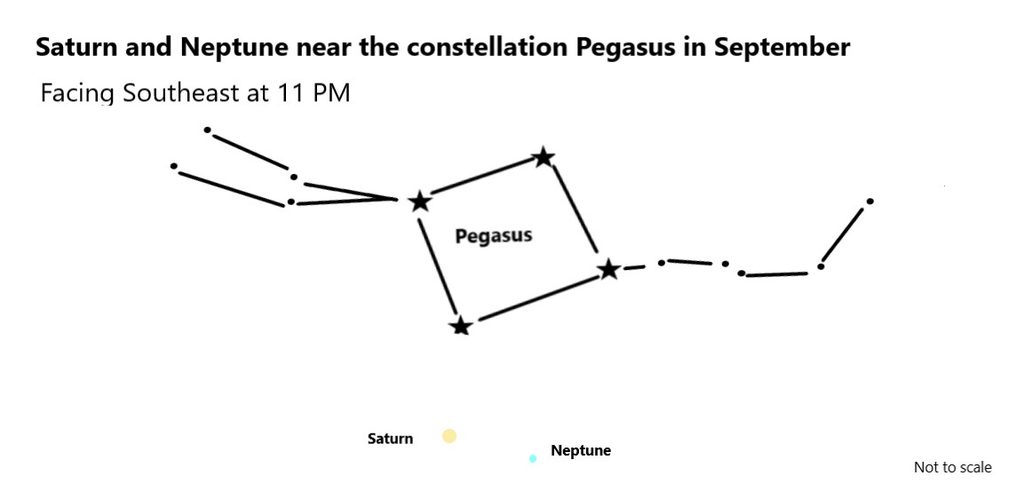
Around 11 PM, Neptune the solar system’s farthest planet will be fairly easy to locate if you have binoculars. Look toward the southeast for the Great Square of Pegasus, a large constellation known for its four distinctive stars. The planet Saturn will be easy to spot at magnitude +0.4 looking like a yellowish star below and to the left of Pegasus. Neptune can be located to the right of Saturn, almost in line with two of the bright stars of the constellation, but you’ll need binoculars. The planet will appear as a tiny disk with a bluish glow shining at a dim magnitude +7.7.
The giant planet Jupiter rises around 4:00 a.m. shining at magnitude -1.8. On Tuesday, September 8, a waning crescent moon is a short distance away. By the last week of the month, Jupiter will be slightly brighter and 30° high in the east by 5:30 a.m. looking like a bright star. (30° can be measured by using your fist held out at arm’s length against the sky. Starting at the horizon, count up three fist-widths which will bring you to the approximate location of Jupiter.)
Note: Astronomers describe the brightness (magnitude) of a star or planet using numbers, with smaller numbers indicating brighter magnitudes and larger numbers indicating dimmer magnitudes. (e.g. This month you’ll find bright Venus at magnitude –4.8 and dim Neptune at magnitude +7.7)
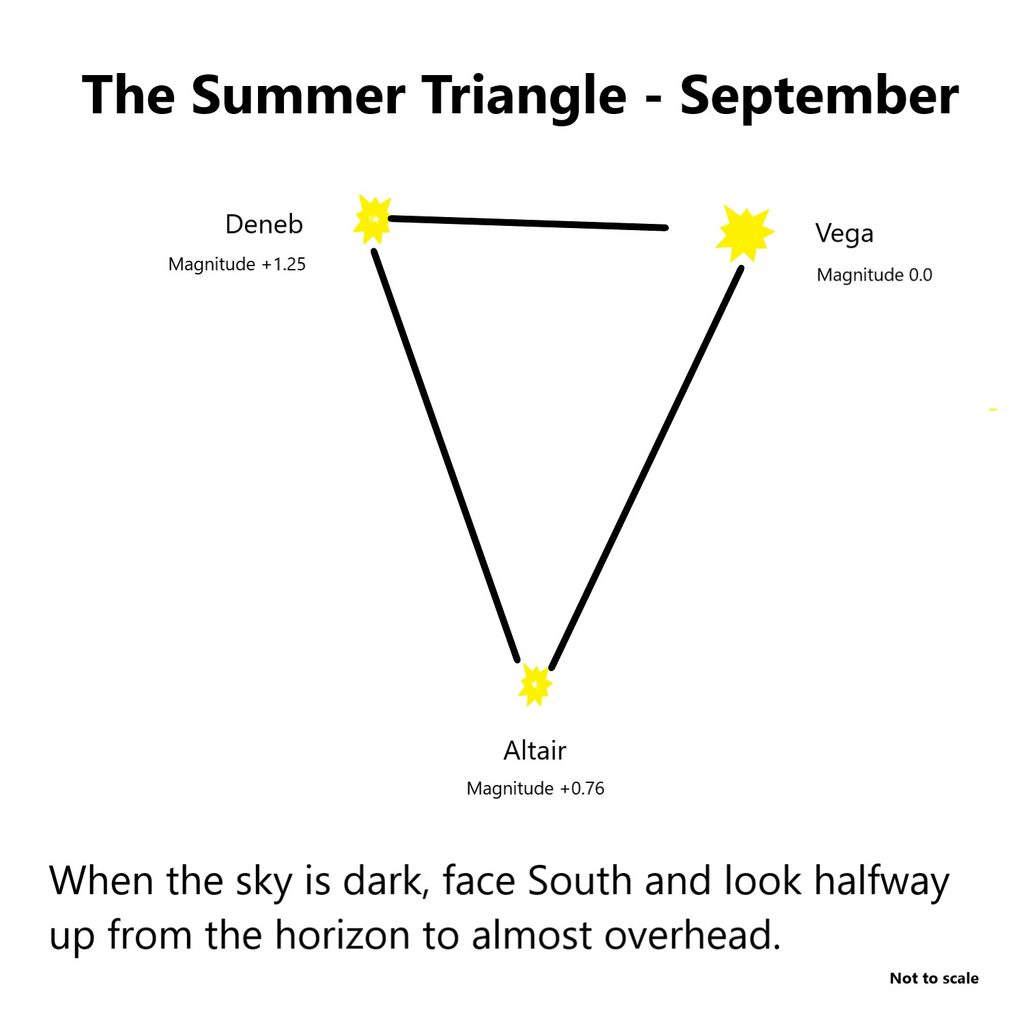
At the beginning of September, face south around 10 PM and look halfway up from the horizon to spot Altair, one of the stars in the asterism known as the Summer Triangle. Altair is located in the constellation Aquila the Eagle. Almost overhead are the two other stars that make up the Triangle – bright Vega in the constellation Lyra, and Deneb in the constellation Cygnus the Swan. Together they resemble a giant triangle appearing earlier at 9 PM in the middle of the month, and 8 PM as September ends. Darkness is arriving earlier as we move into fall heralding the beginning of shorter days and longer nights to enjoy observing the planets and stars.
I bought my husband a telescope for Christmas a couple years ago and he needs help learning how to use it. Is this something you’re organization can help him with?
Certainly! If you could, please send a message on our webform (https://www.rochesterastronomy.org/web-contact-form/) and let us know what kind of scope (make/model) it is. Someone from ASRAS will get back to you soon after and are always happy to help.