Poster’s Note: The text for this month’s installment from Dee Sharples, “The Sky In August 2026,” is provided below. Those wishing to listen to the article can click on the audio link below.
This year the peak of the Perseid meteor shower will be on August 12, and the best times to view the show are early in the morning on Wednesday, August 12 and Thursday, the 13th. With a new moon, there won’t be any lunar glow to brighten the night sky and wash out the dimmer streaks of light. Although the meteor shower will be active from July 17th to August 24th, the maximum rate at the peak could be 100 meteors per hour!
Around 4:00 A.M., find an observing site away from any light pollution. The radiant, or area of the sky from where the meteors will appear to originate, will be 60° high above the horizon in the northeast before dawn. You can expect to see 60-80 meteors per hour from a dark-sky site. If you observe from the city with light-polluted skies, you’ll be able to see only about 50% of the brighter meteors.
The Perseid meteors are created by the Earth traveling through the trail of debris left behind by Comet 109P/Swift-Tuttle which approaches our Sun every 133 years. It last passed closest to the Sun in December 1992 and will return in July 2126.
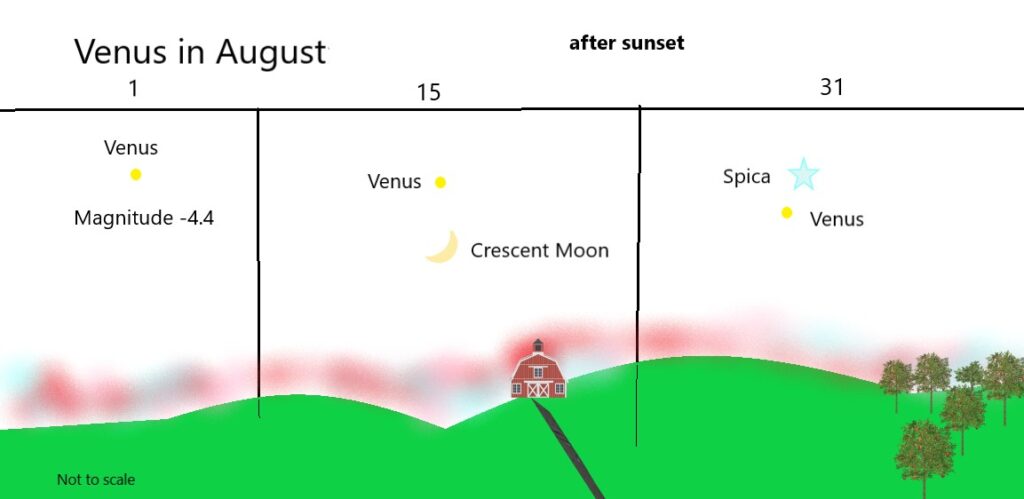
The planet Venus is again a bright target in the evening sky. Look for it shining brilliantly at magnitude -4.4 in the west soon after sunset. On Saturday, August 15th, a crescent moon will lie just below the planet. By Monday, August 31st, Venus will be 1.7° southwest of the bright blue/white star Spica. (If you hold out your little finger at arm’s length again the sky, it will block approximately 1°.)
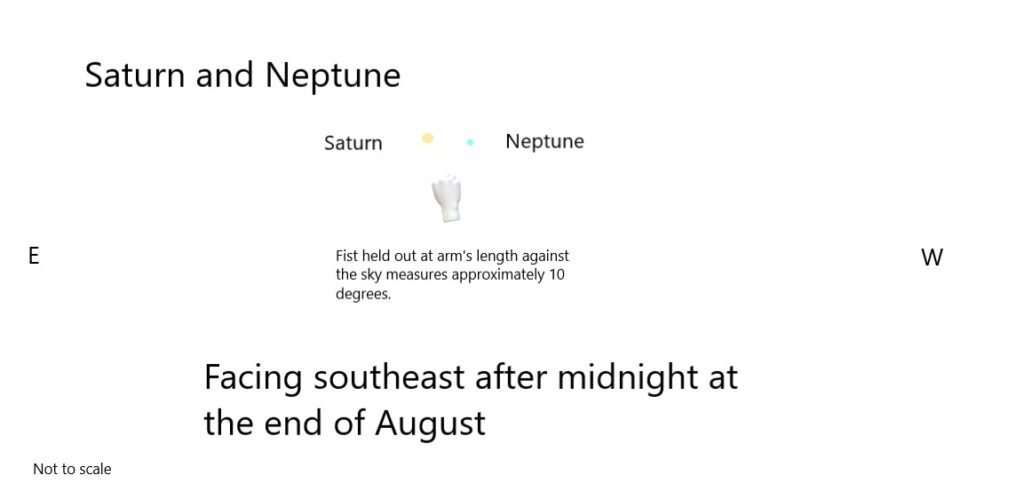
The planet Saturn can be spotted in the eastern sky around midnight and will have moved to higher in the south by dawn. Look for it shining at a respectable magnitude +0.5 before brightening slightly to magnitude +0.4 by the 31st when it will be 10° to the east of our most distant planet Neptune. Hold your fist up to the sky at arm’s length to roughly measure 10°. You’ll need binoculars to spot Neptune looking like a star with a bluish tint.
The planet Mars rises about 2:30 A.M. at the beginning of August looking like a star with an orangish-red hue. It will share the sky with the red giant star Aldebaran. Both will be fairly bright to the naked eye in the constellation Taurus the Bull. On Sunday, August 9th, a waning crescent Moon joins Mars in the sky.
It’s starting to get dark out earlier in August, and the warm temperatures invite comfortable star gazing opportunities.