Poster’s Note: The text for this month’s installment from Dee Sharples, “The Sky In June 2026,” is provided below. Those wishing to listen to the article can click on the audio link below.
The planets Mercury, Venus and Jupiter highlight the evening sky this month. On Monday, June 1st, look west for the planet Mercury which is the planet closest to the Sun. It will be easy to find 30 minutes after the sun sets, but it lies close to the horizon, so find an observation site which will give you a clear, unobstructed view. It will look like a bright star at magnitude -0.5 before it begins to dim within a week. Mercury revolves around the sun in only 88 days, compared to Earth which takes 365.25.
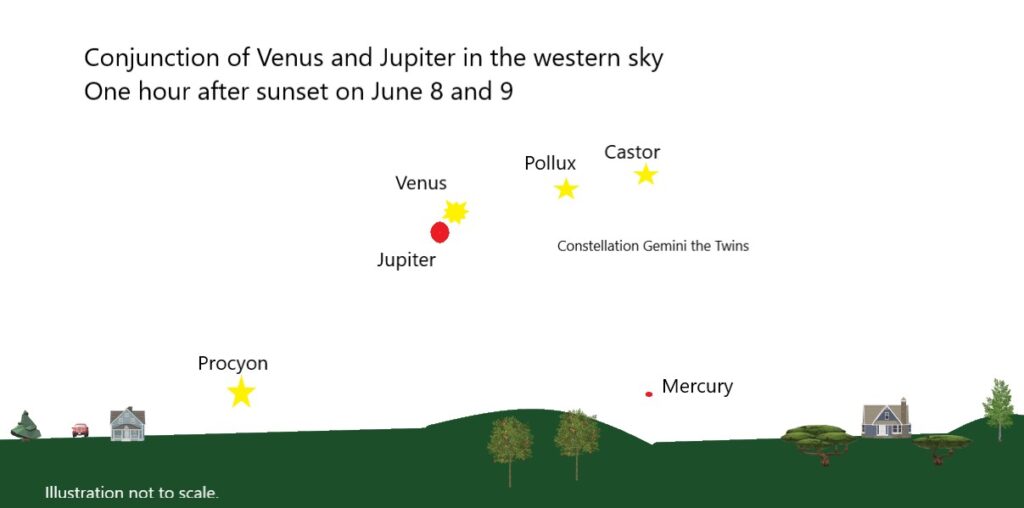
Two other bright planets can also be seen in the western sky along with Mercury and will be hard to miss. One hour after sunset on Monday and Tuesday, June 8th and 9th, Jupiter shining brightly at magnitude -1.9 and Venus at a dazzling magnitude -4.0 will reach conjunction where they will appear to lie very close to each other. In reality, these two planets are separated by millions of miles, but they will appear to be about 1.6° apart from our vantage point on Earth. To measure the space between them, hold your little finger up to the sky at arm’s length. The area of sky blocked by your finger is approximately 1°. To the upper right, you’ll spot the two brightest stars in the constellation Gemini the Twins. They represent two brothers, Pollux and Castor, based on stories from Greek and Roman mythology.
For people who rise early, on Friday, June 12th, look east around 4:30 a.m. which is one hour before the sun rises. A waning crescent Moon lies fairly low in the sky, with the planet Mars looking like a reddish/orange star shining at magnitude +1.3 directly below it. Higher in the southeast, above and to the right of the Moon, you’ll spot Saturn looking like a yellow star at magnitude +0.7. It will shine brighter than any star in that area of the sky.
The Summer Solstice, the first day of summer with the most daylight hours, occurs at 4:25 a.m. EDT on Sunday, June 21st. As explained on NASA’s website: “Earth’s tilted axis (of 23.5°) causes the seasons. Throughout the year, different parts of Earth receive the Sun’s most direct rays. So, when the North Pole tilts toward the Sun (on June 21st), summer begins in the Northern Hemisphere. And when the South Pole tilts toward the Sun, it’s winter in the Northern Hemisphere.” On the first day of summer, there will be 15 hours, 22 minutes, 52 seconds of daylight and only 8 hours, 37 minutes, 8 seconds of darkness.
Summer is a great time to enjoy the starry sky. Evenings and early mornings offer plenty of interesting and beautiful sights in June.