Poster’s Note: The text for this month’s installment from Dee Sharples, “The Sky In October 2026,” is provided below. Those wishing to listen to the article can click on the audio link below.
The days are growing shorter and darkness is arriving sooner in the evening. The many months we’ve been seeing the bright planet Venus in the sky at sunset are all but over. But Venus can still be spotted from a flat observing site, free of any obstacles, very low near the western horizon just as the sky darkens. Under the right observing conditions, it will be easy to pick out, shining at a brilliant magnitude -4.8, but only early in October.
The ringed planet Saturn will be a highlight in the night sky this month. Beginning in early October, it rises around 7:00 p.m. and will be visible in the sky until daybreak. It shines fairly brightly at magnitude +0.3 and can be easily found. The best time to look for it is between 11:00 p.m. and 1:00 a.m. when it will be high in the south.
Saturn’s position in the night sky as we saw it through a telescope caused its rings to appear almost invisible to us, as they were edge-on to our vantage point on Earth. Now, the rings appear to be tilted once again showing us Saturn’s full southern hemisphere.
If you have a telescope, you can search for Saturn’s largest moon, Titan, looking like a star sitting close to the northern edge of the planet on the nights of October 7–8 and 23-24 and close to its southern edge on the night of October 15-16.
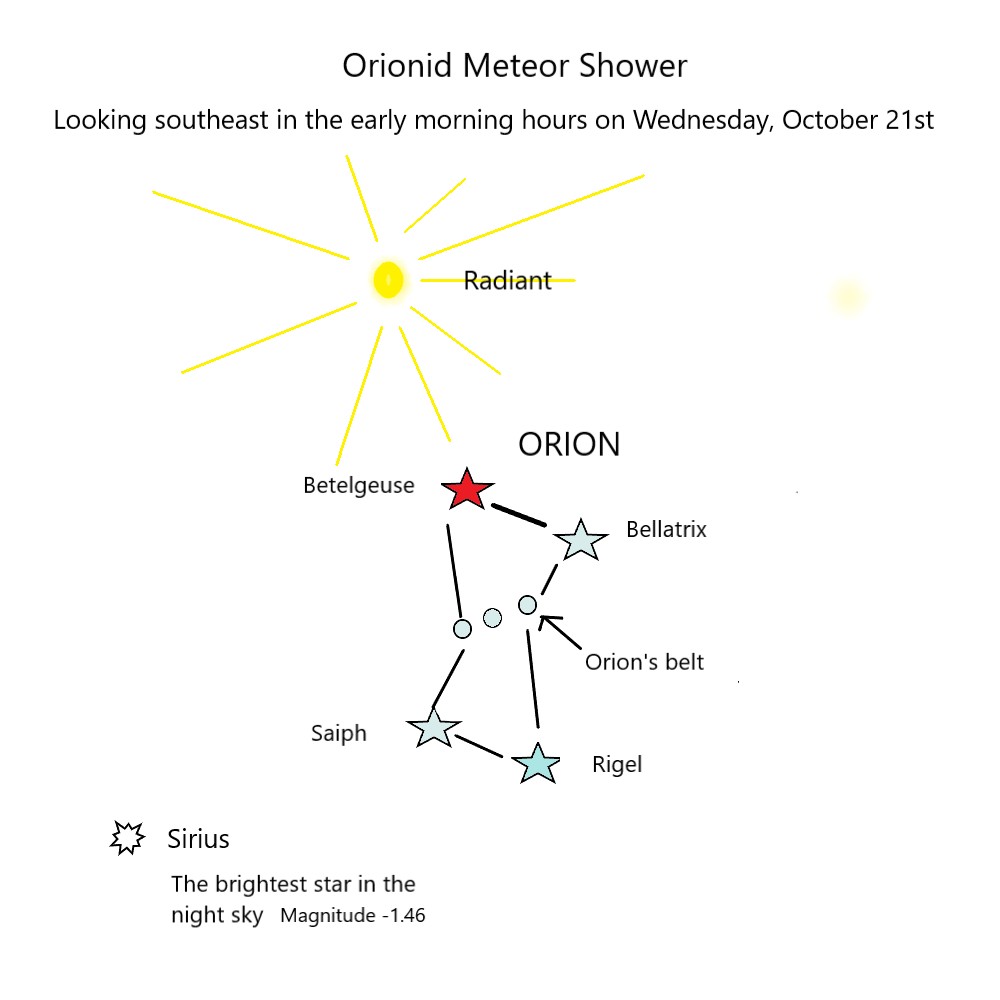
The Orionid Meteor Shower is active from October 2 – November 7, but the peak occurs during the early morning hours of Wednesday, October 21st. A bright Moon that night will wash out all but the brightest meteors so the best time to view will be in the early morning hours after the Moon sets at 2:18 A.M. The radiant, or area of the sky from which the meteors will appear to originate, is just above the stunning constellation Orion the Hunter.
Face southeast to spot Orion high in the sky. While you scan the sky for meteors, which can appear in any direction, you can enjoy the stars making up this constellation, as well as the star Sirius, the brightest star in the night sky, just below it.