Poster’s Note: The text for this month’s installment from Dee Sharples, “The Sky In January 2026,” is provided below. Those wishing to listen to the article can click on the audio link below.
It’s January and we’re in the grip of winter. The cold air temperatures containing less water vapor make our skies look crystal clear when the clouds take a break. This can display dramatic starry nights, but remember a critical rule – dress very warm if you’re going to do any amount of star gazing.
Several naked eye objects will highlight January nights. The giant planet Jupiter shines brilliantly in the sky all night at magnitude -2.7. Look for it in the constellation Gemini the Twins rising in the east around 8PM. By midnight, it will have risen to 60° above the southern horizon. To measure how high above the horizon you’ll find Jupiter, hold your fist out at arm’s length against the night sky. Starting at the horizon, count your fist-widths up to bright Jupiter which will be easy to spot. Each fist-width is equal to about 10°.
The stunning winter constellation, Orion the Hunter, can be found in the south-southeastern sky at 9PM at the beginning of the month, rising a few minutes earlier each night until by the end of January, it can be seen at 7PM. The constellation, Gemini, and the planet, Jupiter, will be in the same area of the sky.
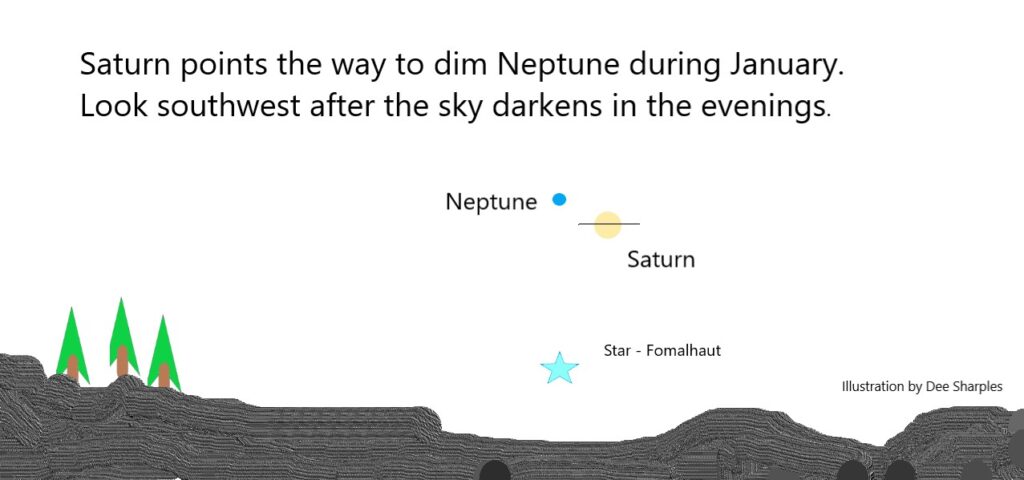
Saturn (the ringed planet) and Neptune (the solar system’s farthest planet) can be seen in the same binocular field of view throughout January. Although Saturn will shine at bright magnitude 1.0 and can be seen naked-eye, you’ll need binoculars to spot Neptune at a very dim magnitude 7.8. Neptune will lie about 2° to the northeast of Saturn looking like a tiny bluish disk. Look for them low in the southwest after the sky is dark in the evening around 7PM before they set.
The Quadrantid meteor shower is active until January 12th with its peak on January 3rd. Although an occasional meteor can be spotted in the first two weeks of the month, the maximum rate at its peak could be 80 meteors per hour. Unfortunately, a full Moon at the peak will dim all but the brightest meteors. The radiant, or area of the sky where the meteors will appear to originate, will be in the constellation Boötes in the east at 4AM.
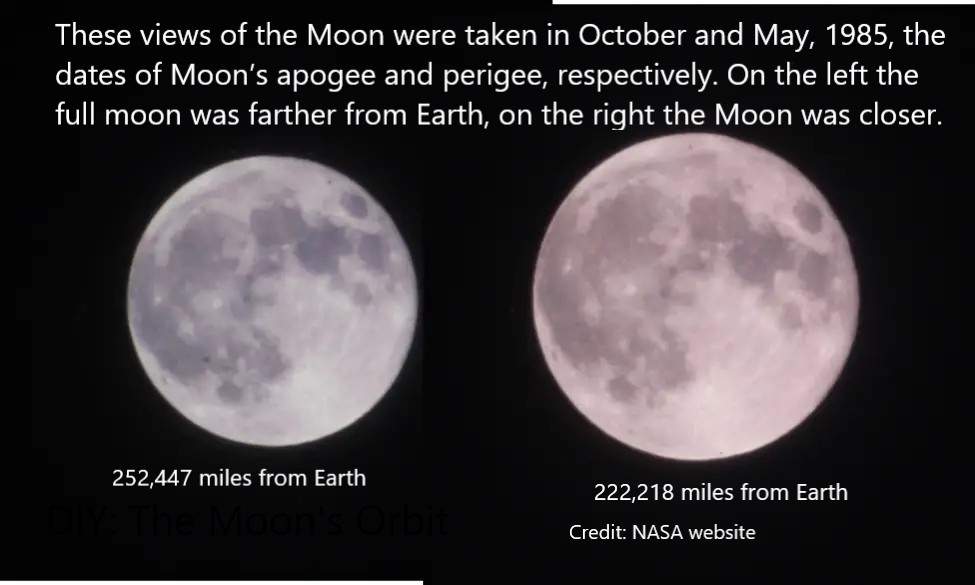
The Moon will be at apogee (farthest from the Earth) at 251,928 miles on January 13th. On the 29th, it will be at perigee (closest to Earth) at 227,341 miles, a difference of 24,587 miles. This occurs because the Moon in an elliptical orbit around Earth, not perfectly circular. If you could view them side-by-side, you’d be able to notice the difference.