Poster’s Note: The text for this month’s installment from Dee Sharples, “The Sky In February 2026,” is provided below. Those wishing to listen to the article can click on the audio link below.
February plays host to several planets in the evening sky. Jupiter, the largest planet in our solar system, is visible all night outshining the stars at magnitude -2.7. Look for it as darkness falls, appearing like a bright star high in the east and watch it track across the sky toward the south. By morning light, Jupiter will have set in the west.
Jupiter’s four largest moons, looking like tiny stars, revolve around the planet in ever-changing positions and are interesting to identify on any given night. A good pair of binoculars or a telescope of any size will help you see them. Reference Sky & Telescope magazine’s website to identify them at:
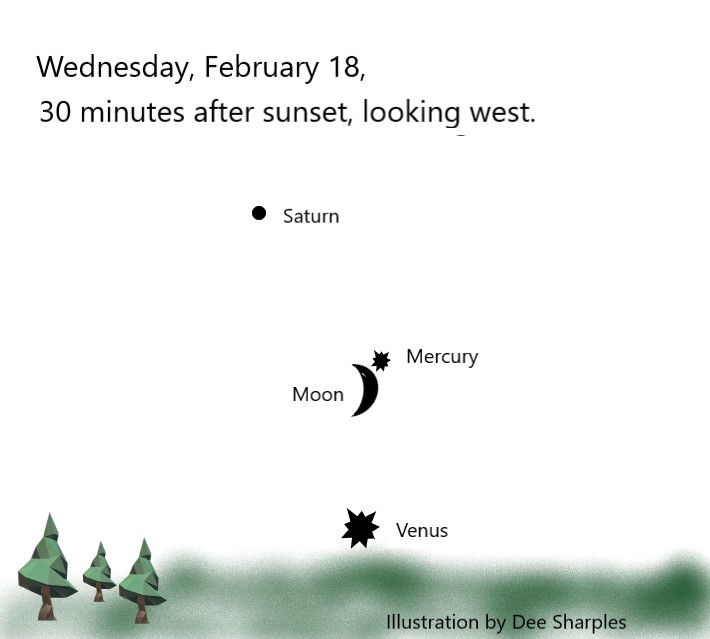
Mercury, the planet closest to our Sun, can be found starting Tuesday, February 10th, close to the western horizon 30 minutes after the sun sets. You’ll need an observing site free of obstacles to spot it at a bright magnitude -1.1, a mere 7° above the horizon. A thin crescent Moon positioned near Mercury will help you find it on Wednesday, the 18th.
The brilliant planet Venus shining at magnitude -3.9 will be below Mercury and only 1° high. Saturn, the ringed planet, will become visible as the western sky darkens, but it will be dimmer than Mercury and Venus at only magnitude 1.0. Look for Saturn about 30° high above the crescent Moon that same evening.
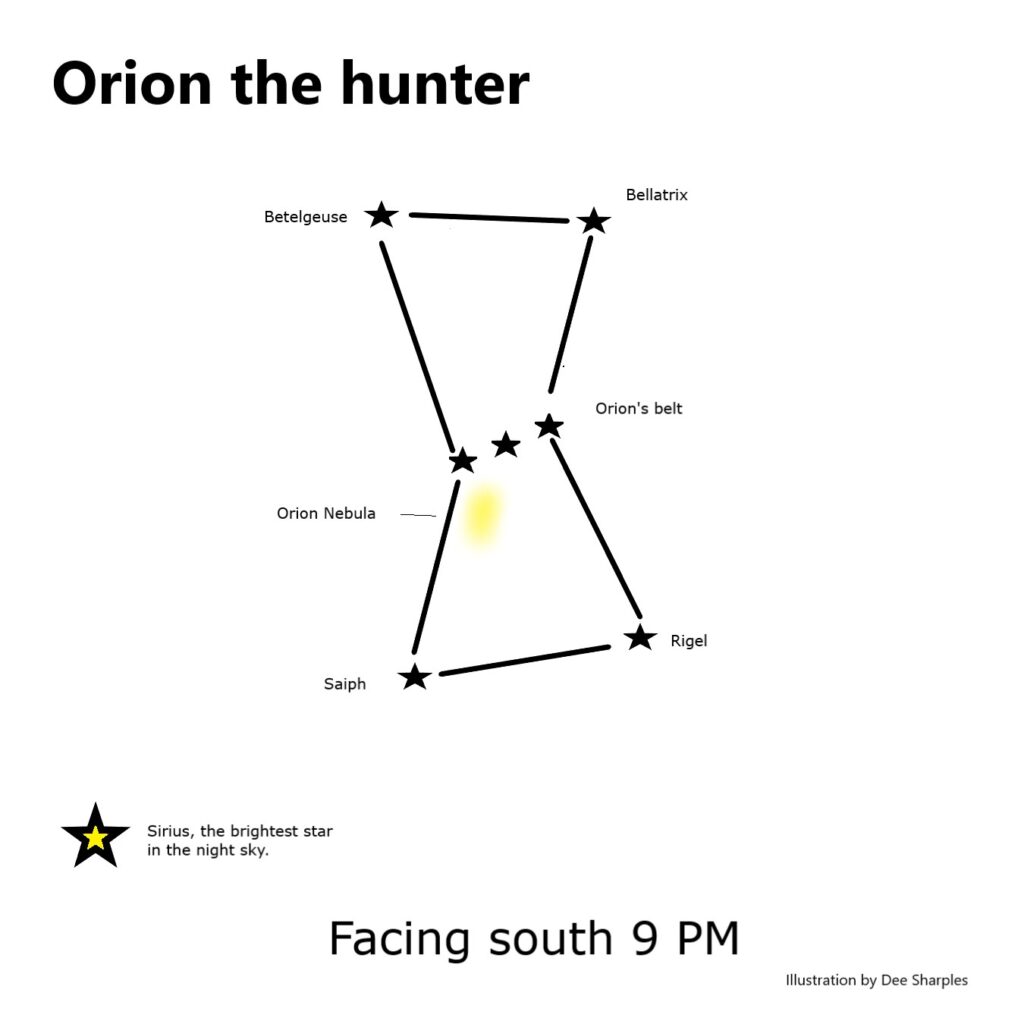
The constellation Orion the Hunter continues to dominate the night sky in the south for the month of February. Its distinctive and easily identified configuration of stars makes it a satisfying target in the cold winter sky and a great one to point out to children.
NASA’s Artemis program is a series of increasingly complex missions that will enable human exploration at the Moon and future missions to Mars.
NASA’s website states: “With NASA’s Artemis campaign, we are exploring the Moon for scientific discovery, technology advancement, and to learn how to live and work on another world as we prepare for human missions to Mars. We will collaborate with commercial and international partners and establish the first long-term presence on the Moon.”
Artemis I was an uncrewed flight test of the Space Launch System (SLS) and the Orion spacecraft around the Moon. Launched on November 16, 2022, its complicated trajectory to the Moon lasted over 25 days and returned successfully to Earth on December 11.
The Artemis II flight, which will hopefully launch soon but no earlier than February 6, 2026, will be NASA’s first in the Artemis program with a crew of four astronauts. It will be a 10-day mission and complete a lunar flyby.
NASA states: “Artemis III will send the first humans to explore the region near the lunar south pole. Artemis IV debuts humanity’s first lunar space station, a larger, more powerful version of the SLS rocket, and new mobile launcher.”