Poster’s Note: The text for this month’s installment from Dee Sharples, “The Sky In December 2025,” is provided below. Those wishing to listen to the article can click on the audio link below.
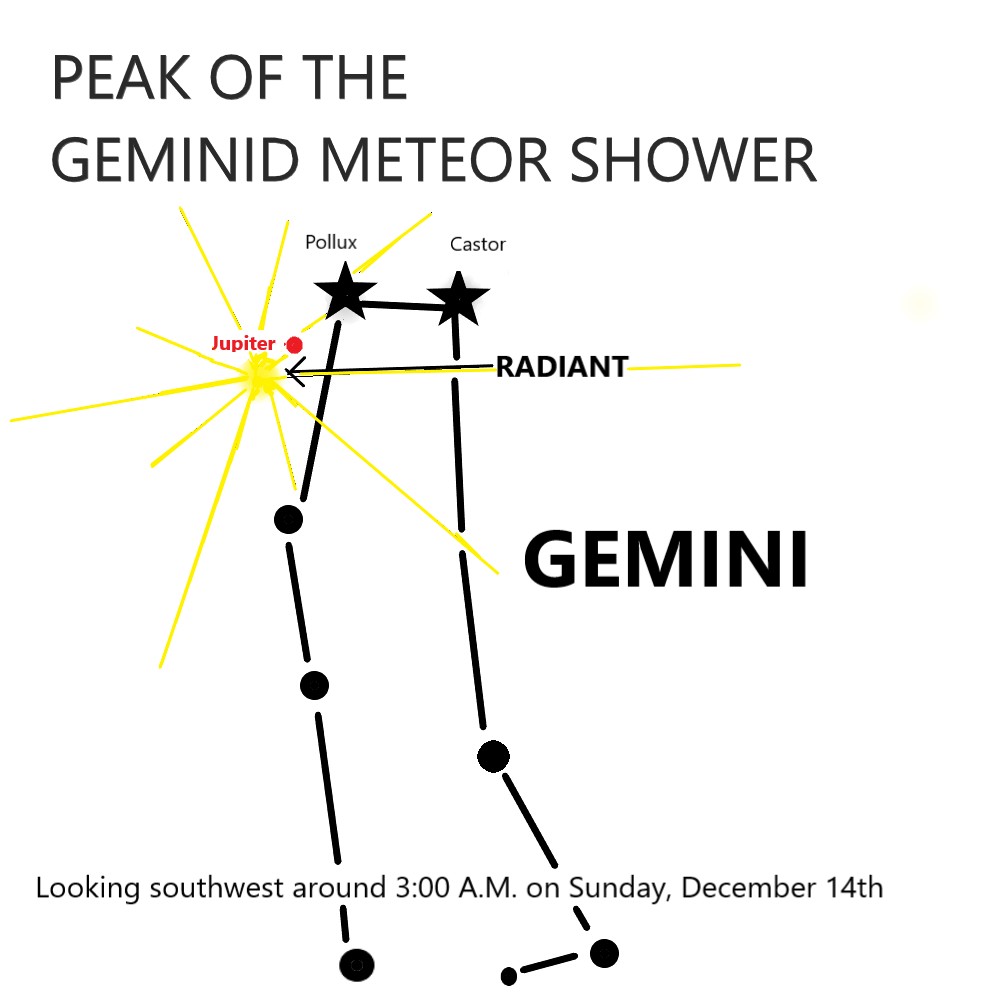
December hosts the Geminid Meteor Shower which peaks on Sunday, December 14th. The meteor shower is active from December 4th to 17th when some meteors can be seen crossing the sky, but at its peak on the 14th, it’s possible to see 100 meteors per hour at a dark sky site away from the city. The best chance of seeing the most meteors is in the very early morning hours.
If you’re viewing from your own backyard, position yourself in the darkest spot shielded from any lights. Unfortunately, a waning crescent Moon will also contribute to unwanted light so try to be in the shadow of a building or tree. Dress very warm and bring out a hot drink and a comfortable chair. Observing meteors in the winter creates a challenging environment and you need to be prepared for cold temperatures.
The meteors will appear to originate from the constellation Gemini which will be high in the southwest after midnight. The Geminids are considered one of the best meteor showers of the year and will appear as so-called “shooting stars” in any part of the sky.
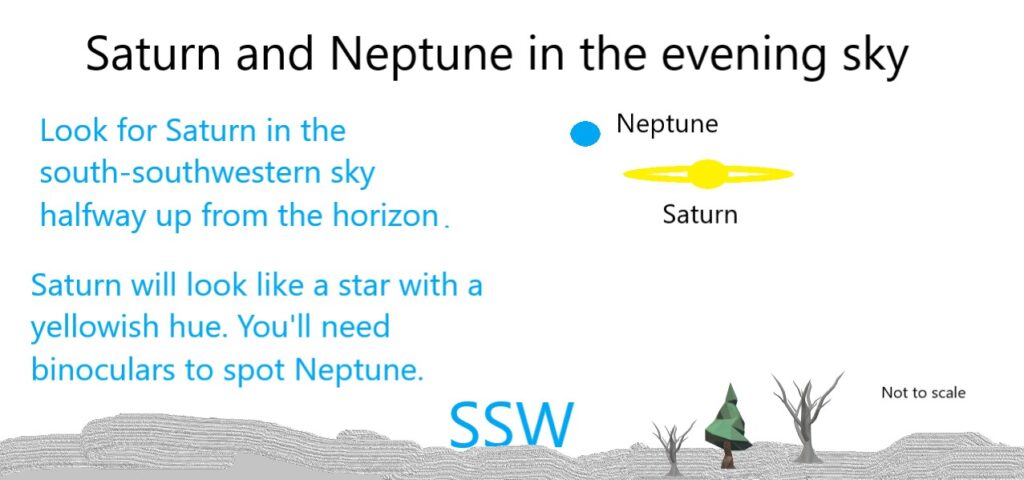
The planet Saturn is easy to find in the south-southwestern sky halfway up from the horizon as darkness falls. It will look like a bright yellowish star, outshining all the stars in that region of the sky. The planet Neptune shining much dimmer at magnitude 7.7 lies nearby, but you’ll need binoculars to see it. Through binoculars, it will appear as a disk-like object with a bluish hue to the left and above Saturn.
The giant planet Jupiter rises in the east about 7:45 p.m. at the beginning of the month, shining at a dazzling magnitude -2.6. It will rise a little earlier each night and move to high in the south as the night progresses, then fading in the west as dawn brightens the sky.
The winter solstice occurs on Sunday, December 21, at 10:03 a.m. EST. This is the shortest day of the year with only 8 hours, 59 minutes, 10 seconds of daylight. But after that, the days will begin to get longer, at first by only a few seconds, then by minutes, as we move toward spring.