Poster’s Note: The text for this month’s installment from Dee Sharples, “The Sky In March 2026,” is provided below. Those wishing to listen to the article can click on the audio link below.
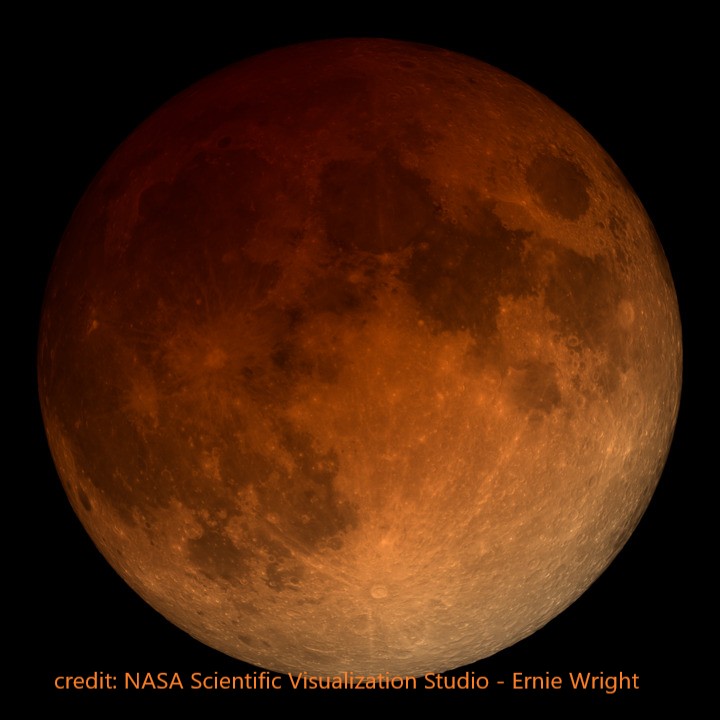
A total lunar eclipse presents an early morning show this month. At 3:43 AM, on Tuesday, March 3rd, the Moon will have already risen and will be high in the south. Sunlight reflecting off its surface is what makes the Moon glow. As the Earth begins to block that light, it casts a faint shadow moving across the face of the Moon. The shadow darkens as the more noticeable partial eclipse phase begins at 4:50 AM. As the Moon moves deeper into the shadow, fainter stars begin to pop into view with the sky darkening over the next hour. The Moon’s surface will take on an orangish hue as it nears totality at 6:04 AM EST. However, twilight will begin to brighten our morning sky when the fully eclipsed Moon sets in the west. People living in Central, Mountain and Pacific time zones will see more of the eclipse in a darker sky.
Every night, one or more planets in our solar system crosses the night sky, shining like stars. Some are very bright, some dimmer, and others you will be able to see only if you have binoculars or a telescope. Two of the brightest planets in March are Venus and Jupiter. The magnitude (or brightness) of a planet or star is measured by astronomers using lower numbers to designate brighter objects. Stars shine because they create their own light through nuclear fusion in their cores just as our Sun does. Planets, however, shine because they reflect sunlight hitting their surfaces. How bright a planet appears to us depends on its distance from the sun and its reflectivity.
Venus is always a reliably bright object because it’s the 2nd closest planet to the Sun and has a high albedo caused by its thick atmosphere which reflects about 70% of the sunlight. This month you can spot Venus blazing at a magnitude -3.9 low in the western sky just after the Sun sets. On Saturday the 7th and Sunday the 8th, Venus lies close to the planet Saturn. Use binoculars to spot Saturn below the bright beacon shining at a much fainter magnitude 1.0.
Jupiter, the largest planet in our solar system, is bright and easily seen in the night sky in March at magnitude -2.3. You can find Jupiter in the evening high in the south moving toward the west by midnight. Even though Jupiter is the 5th planet from the Sun, it shines brightly due to its huge size and high albedo as sunlight reflects off the thick clouds which are at the top of its multi-layered atmosphere.
On Sunday, March 8, at 2:00 AM, move your clocks ahead one hour as we begin Daylight Savings Time. The sky will darken later each evening as we move into the warmer season. Spring equinox occurs on Friday, March 20th at 10:46 AM when we’ll have an almost equal number of hours of daylight and darkness and the promise of spring starts to become a reality.