Poster’s Note: The text for this month’s installment from Dee Sharples, “The Sky In April 2026,” is provided below. Those wishing to listen to the article can click on the audio link below.
The planet Venus is a sparkling jewel in the evening sky in April. It shines at a brilliant magnitude -3.9 just after sunset above the western horizon. As the sky darkens, look for the Pleiades star cluster above it. Binoculars will display this beautiful group of bright stars, also known as the Seven Sisters. On Saturday, the 18th, a crescent Moon sits next to Venus in the evening sky, along with the Pleiades above, presenting a lovely sight.
On Thursday, April 23rd, Venus will point the way to the distant planet Uranus. Point binoculars at Venus and look for a faint star-like object with a bluish-green hue to the lower left of the bright planet. Uranus is an ice giant and the 7th planet in our solar system, about 1.8 billion miles from the Sun.
The giant planet Jupiter shines brightly high above the western horizon after sunset. At magnitude -2.1, it will be easy to spot. If you have a telescope, turn it toward Jupiter on Wednesday, April 1st. Before midnight, the four main Galilean moons of Jupiter will all be on display in order of their distance from the planet. Io is closest to Jupiter, then Europa, Ganymede and finally Callisto, the farthest. Jupiter and it’s four largest moons are interesting to observe on any night as they continually travel around the planet.
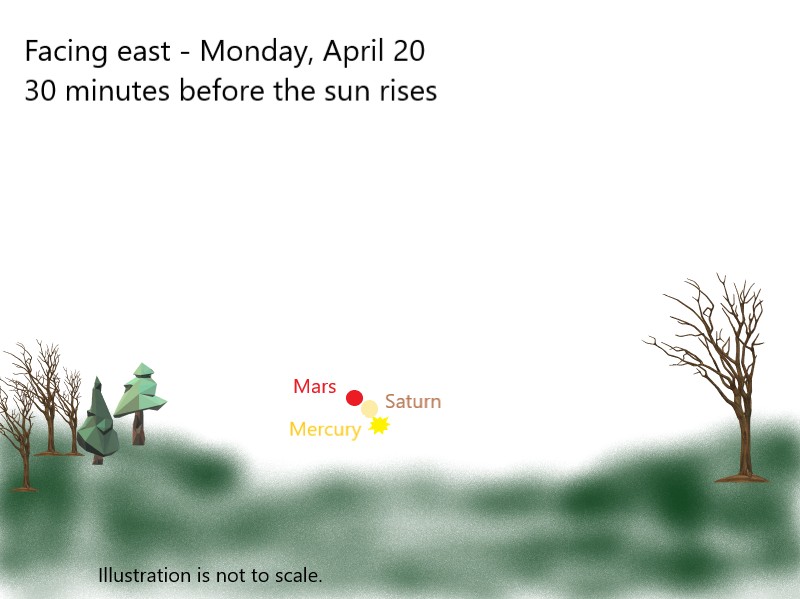
For those who rise before the Sun in the morning, there’s a close grouping of three planets on Monday, April 20th, low in the east. Thirty minutes before sunrise, find a flat observing location free from any obstacles such as buildings and trees. The planets Mercury, Saturn and Mars will appear in a tight line only 2° above the eastern horizon. Mercury, shining at a bright magnitude -0.2, can be seen naked-eye, but you’ll need binoculars to spot the other two which are dimmer. Saturn, at magnitude 0.9, can be found just north of Mercury and Mars, the faintest at only magnitude 1.2, will be north of Saturn.
The Lyrid meteor shower peaks in the early morning hours of Wednesday, the 22nd. After a thin crescent moon sets around 1:30 A.M., the dark sky will be ideal for spotting meteors. The radiant, or area of the sky where the meteors will appear to originate, will be high in the east in the constellation Lyra, near the bright star Vega. This meteor shower produces a rate of about 20 meteors per hour from a dark-sky observing site and worth the drive to an area away from city lights.
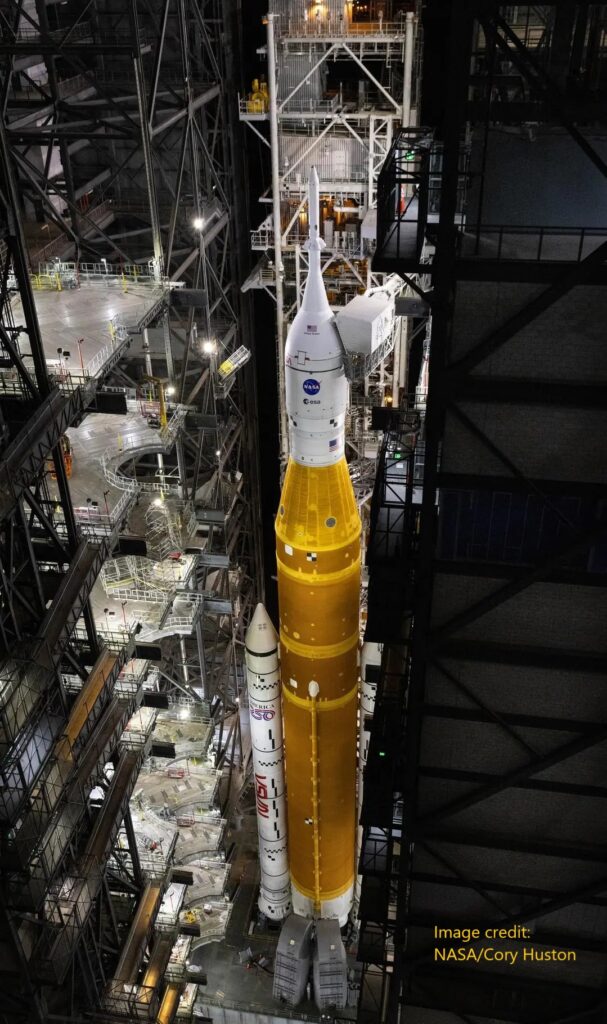
Artemis II, NASA’s mission to send four astronauts on a 10-day mission around the Moon, was previously postponed in March due to technical issues. NASA has indicated that one opportunity to launch from the Kennedy Space Center is on Wednesday, April 1st.